ObsoleteSony.com
1979
TPS-L2
Walkman
The TPS-L2 was Sony's first Walkman, launched on July 1, 1979 as a playback-only stereo cassette player...
obsoletesony.com/walkman/tps-l2

If you find it useful, you can support it. Support the archive


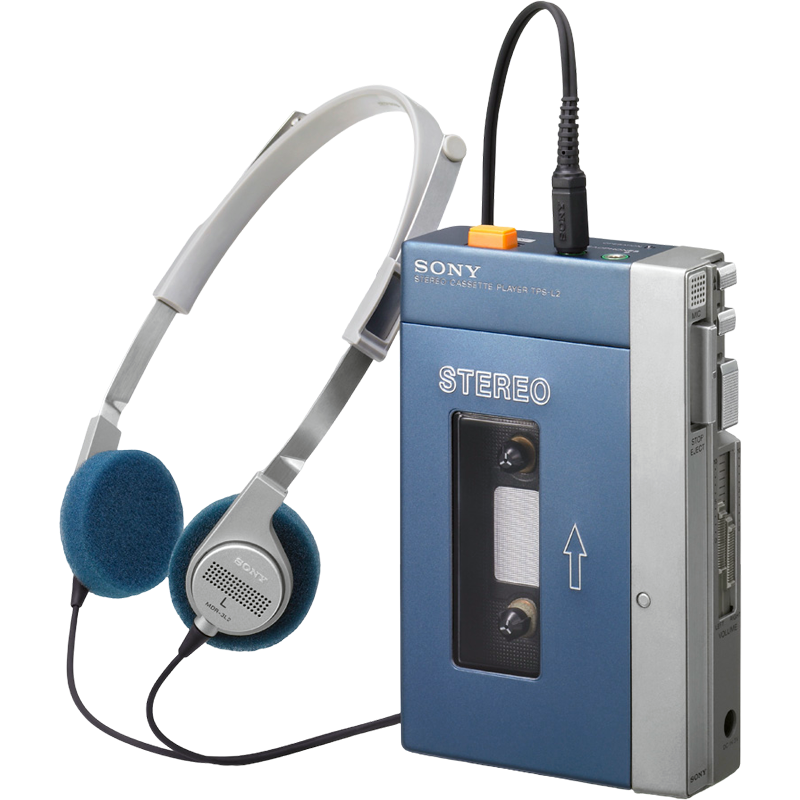
The TPS-L2 was Sony's first Walkman, launched on July 1, 1979 as a playback-only stereo cassette player built from the body of the existing Pressman TCM-600 recorder. Sony removed the recording circuitry and focused the machine entirely on listening, resulting in a compact blue-and-silver metal body powered by two AA batteries. Its belt-driven transport provided stable cassette playback, while the two headphone jacks encouraged shared listening and the Hotline button activated a built-in microphone so listeners could talk briefly without taking off their headphones.
It belongs to the moment before the Walkman was really a category, when Sony was still testing whether private listening on the move could make sense as a mass habit. What made the TPS-L2 important was not technical sophistication so much as clarity of purpose: versatility was traded for portability and immediacy. It feels less like a finished member of a product family than the machine that accidentally opened the door for everything that followed.
The idea that became the Walkman began with Masaru Ibuka, Sony's co-founder, who often traveled with a TC-D5 recorder so he could listen to music during long flights. He enjoyed having music with him, but the hardware was too large to treat as a daily companion. Early in 1979 he asked the audio division for something much smaller, a player built purely for listening and light enough to carry every day. Norio Ohsone passed the request to a small engineering team led by Shizuo Takashino. They did not begin from scratch.
Instead they modified the TCM 600 Pressman, a compact mono recorder used by journalists. By removing the recording circuitry and adapting the transport for stereo playback, the team produced a working prototype in three days. It was rough, but it proved that a field recorder could be reshaped into a personal stereo, and the idea moved forward inside Sony. Akio Morita understood the potential and pushed for a summer release. The Walkman needed to reach the market in just four months.
Morita and Ibuka set the specifications themselves: playback only, low weight, two headphone jacks, and no unnecessary features. With normal procedures set aside, engineers refined the layout, reinforced the chassis, and tuned the audio path until it met Sony's standards. The result was the TPS-L2, a blue and silver metal player that weighed 390 grams and ran for eight hours on two AA batteries. Paired with the MDR-3L2 headphones, it introduced a new kind of portable listening. Naming followed the same instinct for directness.
Sony considered several safer options, but Morita approved Walkman because it felt memorable and carried a sense of personal movement. No one expected the word to spread globally, yet it did. The TPS-L2 changed how people related to music. Listening moved out of the room and into everyday life. What began as Ibuka's personal request became a global habit, and the Walkman entered everyday life in a way no one inside Sony had predicted.