In 1992, Sony introduced the MiniDisc format. Designed as a portable audio system with a different structure from cassettes, it integrates recording capabilities, vibration resistance, and high-speed access.
MZ-1
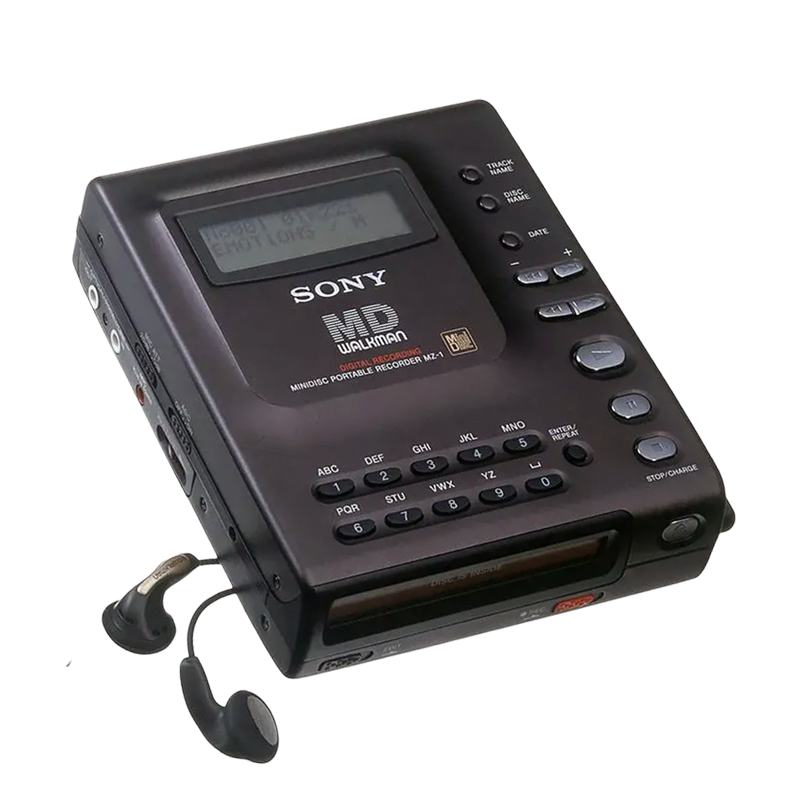
The MZ-1 was the first MiniDisc recorder to replace linear tape with random access discs, significantly changing how recorded audio was handled. Its configuration, which allowed for track splitting, merging, moving, and deletion without affecting other recordings, revolutionized editing operations in portable audio. It supported recording from microphone, line, and optical digital inputs, and also featured manual level adjustment and real-time monitoring. ATRAC compression reduced data size, enabling digital recording without requiring the same recording capacity as uncompressed audio. The motor-driven loading mechanism and large chassis housed the early optical and magnetic components, and the basic operational configuration of MiniDisc-including recording, editing, and disc management-was established at this stage.
MZ-2P
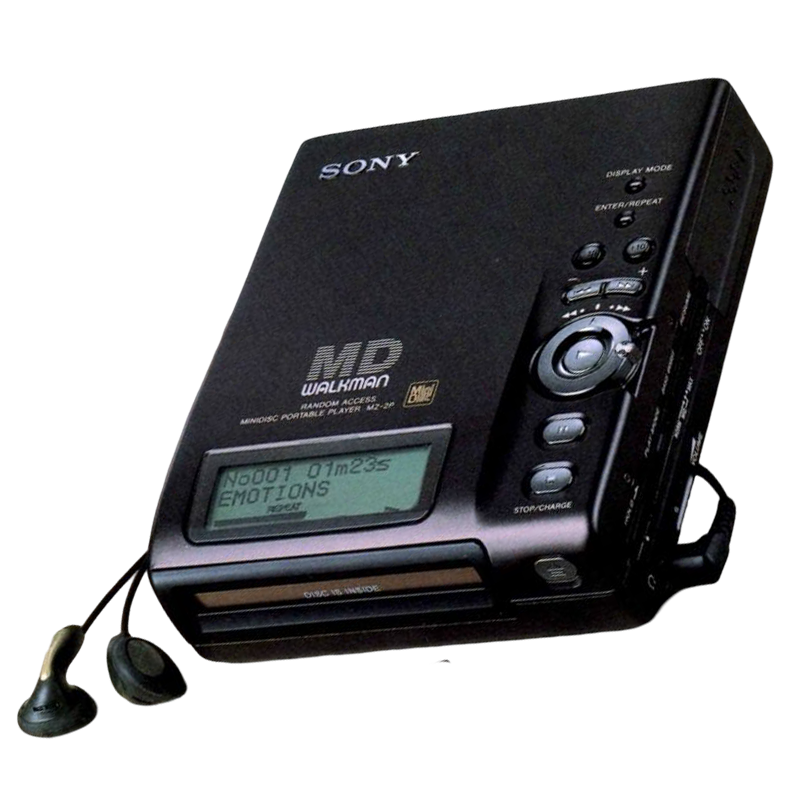
The MZ-2P is a playback-only MiniDisc unit that removes recording to focus entirely on listening. It uses the same disc reading system and compressed audio playback as the original recorder. Control is built around a shuttle mechanism for cueing and track navigation, alongside playback modes such as repeat and shuffle. A display shows track and disc information, while bass enhancement adjusts low-frequency output during playback. The unit remains large and retains much of the mechanical complexity of early MiniDisc hardware, using the same battery system with limited runtime.
In 1992, MiniDisc became a commercially available product. At the same time, the basic structure for portable recording, high-speed access, and digital audio playback was established.