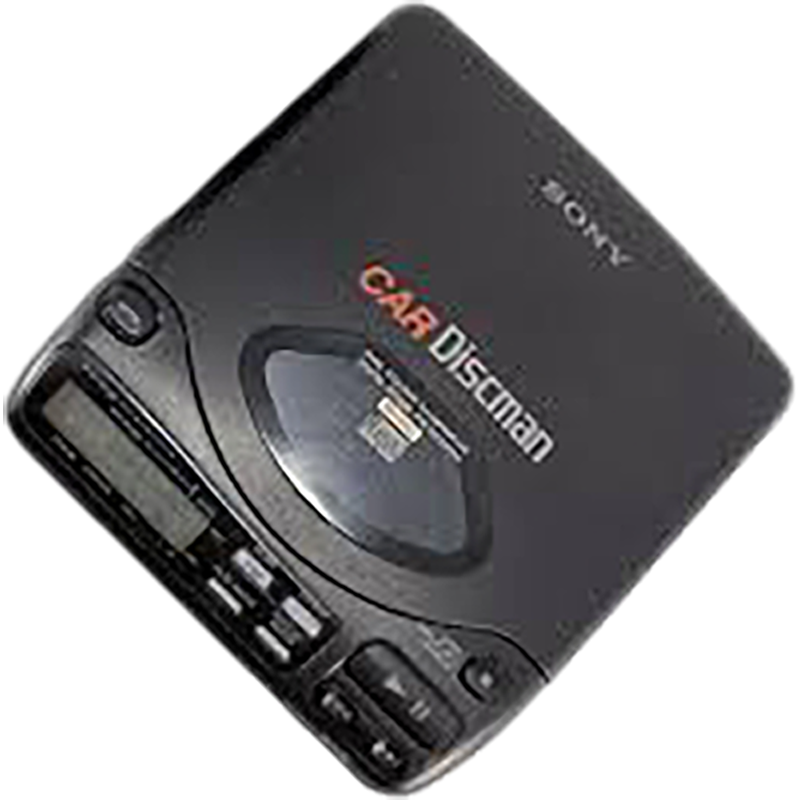
By 1991, Sony was still shrinking the chassis and simplifying controls to make the Walkman feel effortless in daily use. The focus stayed firmly on analog cassette performance while the designs grew more intuitive.
WM-DD33
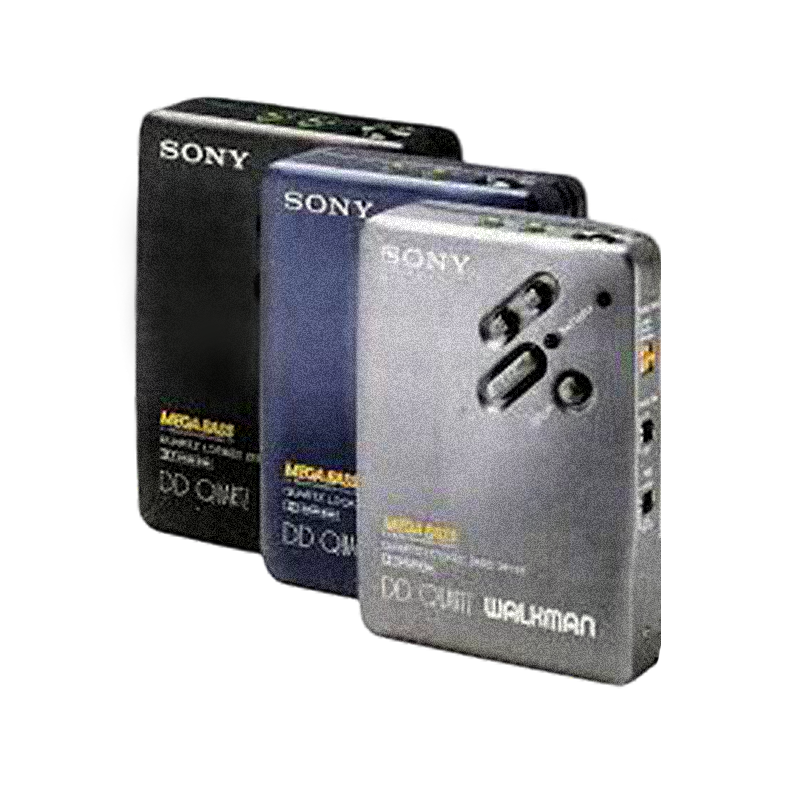
The WM-DD33 is the final major Disc Drive Walkman and the rounded, more modern-looking successor to the DD30, carrying Sony's direct-drive premium playback philosophy into the early 1990s. It retained the Disc Drive transport, Dolby B noise reduction, Mega Bass, anti-rolling support, and manual tape selection, but updated the body with softer contours and slightly more contemporary industrial design. It also holds a compact but meaningful place in the line as the last Sony portable cassette player to retain dual headphone jacks. The DD33 closes one of the most serious engineering branches in the entire Walkman story. By 1991, much of the lineup had moved toward convenience, style, and feature packaging, but the DD33 still belonged to the older idea that transport quality itself still counted. It was the final clean expression of Sony's high-end portable cassette philosophy before that branch ended.
WM-DX100
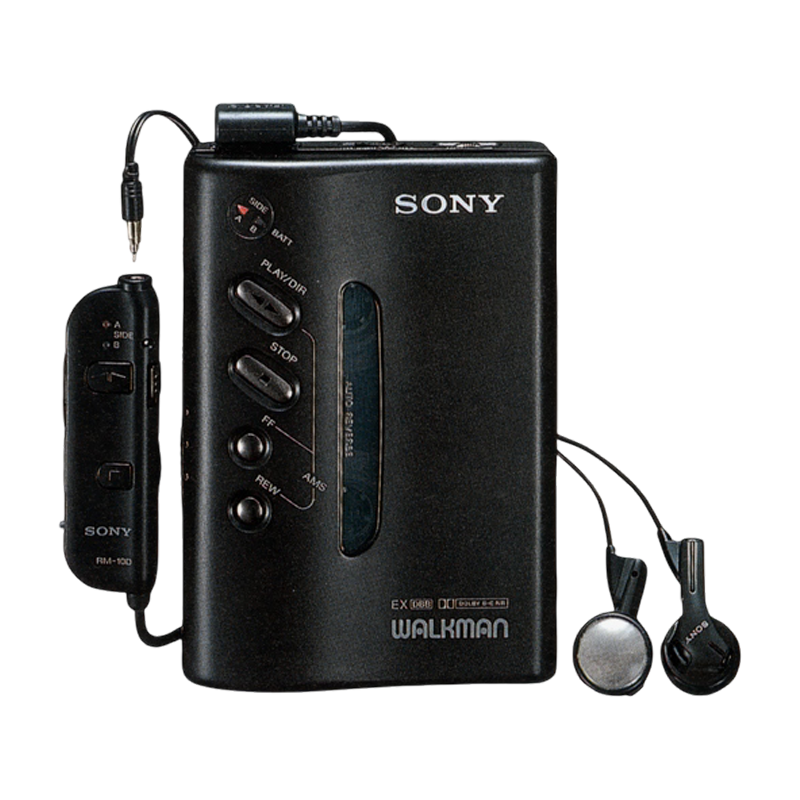
The WM-DX100 was a high-end playback Walkman from Sony's DX series in 1991, conceived as a more portable evolution of the company's serious sound-oriented cassette players rather than a lightweight fashion model. Its transport used a hybrid drive system in which a cylindrical motor rotated a brass rotor disc that then drove the tape mechanism under PLL servo control, balancing compactness with unusually stable tape speed. Sony combined this with an EX Amorphous Head, Dolby B and C noise reduction, Extended Dynamic Bass Boost, auto-reverse, and the Sound Swing Guard anti-vibration system, while the metal body and center-locking aluminum lid gave the machine a noticeably dense and protected feel. This is one of those models where Sony was clearly trying to preserve the idea of top-tier cassette playback without carrying forward all the physical seriousness of the earlier DD flagships. The DX100 makes sense as a commuter-era evolution of the high-end Walkman: still technically ambitious, but more concerned with surviving movement, routine use, and daily handling than with making a spectacle of its mechanism. It reads as the point where portable fidelity became something Sony wanted to package more elegantly.
WM-EX77
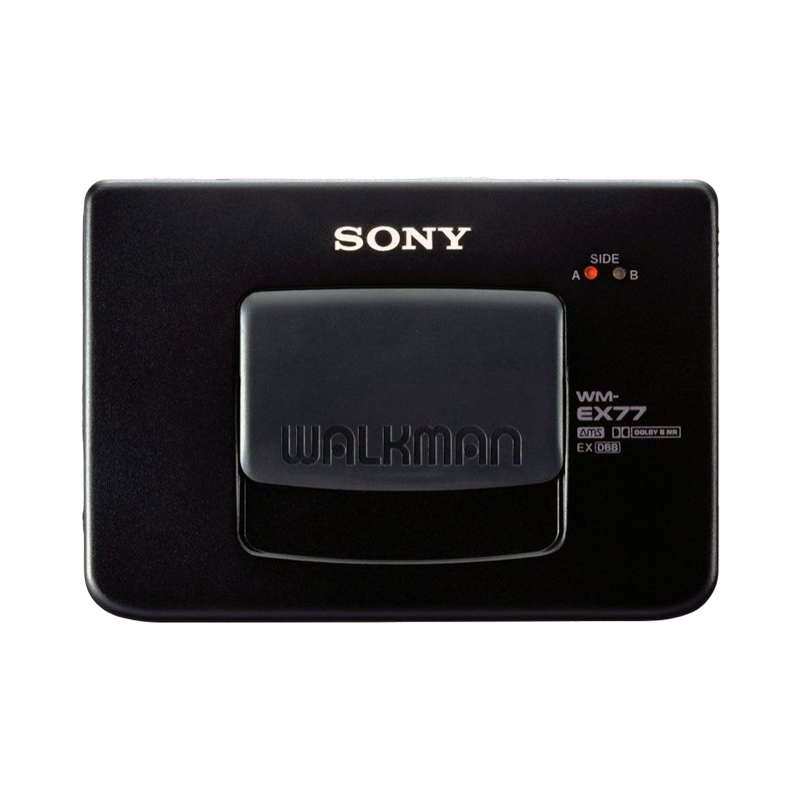
The WM-EX77 is a mainstream EX-series playback Walkman from 1991 that combined Sony's newer anti-roll motion-stability system with a deliberately youthful presentation, most visibly through its pastel finishes in pink, mint green, and lavender blue. It retained the familiar late-period EX formula of an EX Amorphous head, auto-reverse, Dolby B noise reduction, Extended Dynamic Bass Boost, logic controls, and a basic wired remote, all inside a slim metal-framed body. The includes teardrop earphones were also part of the package logic, built to reduce sound leakage while keeping the overall experience light and casual. This model shows Sony fully accepting that the Walkman was now as much about personality and everyday carrying as it was about audio hardware. Here, not a stripped-down toy or a disguised flagship, but a carefully tuned middle-range model with just enough technical polish to feel modern and just enough color to feel personal. It sits within the point when style and reliability were no longer competing priorities.
WM-EX88
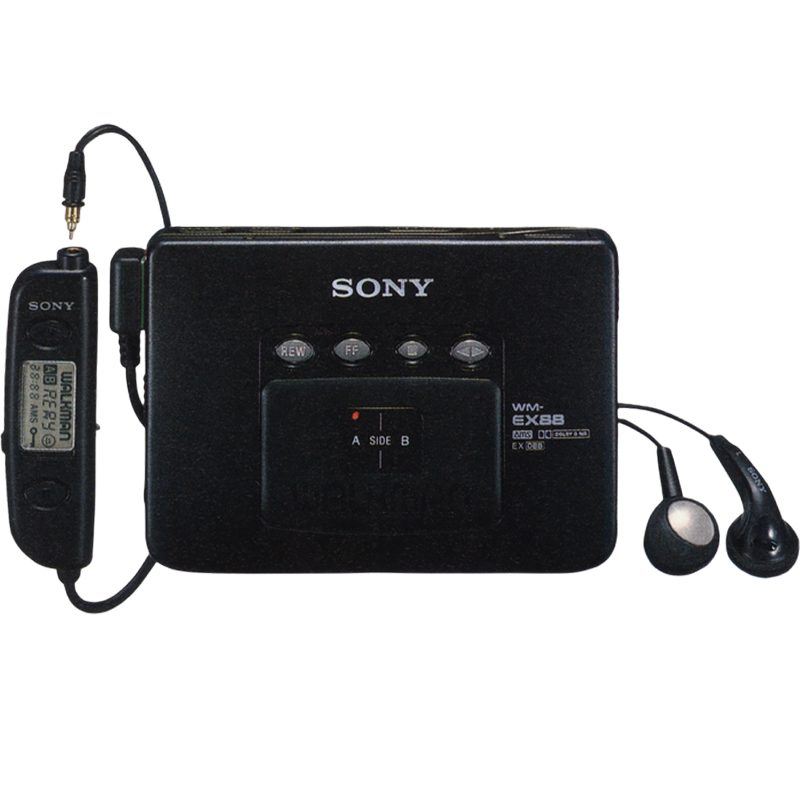
The WM-EX88 was a high-end playback Walkman from Sony's EX family in 1991, distinguished by the introduction of a sliding hold lock built directly into the cassette lid so the latch engaged automatically when closed. The lid also carried the main control keys, giving the machine a cleaner and more self-contained interface than many nearby models. Beyond that, it offered an EX Amorphous Head, auto-reverse, Dolby B, Extended Dynamic Bass Boost, AMS track search, AVLS volume limiting, Sound Swing Guard anti-vibration control, and an LCD remote connected through Sony's small gold-plated micro-plug system. It shows Sony moving some of its innovation away from pure transport mechanics and toward interaction design. The EX88 is not important because it radically changed cassette playback, but because it made the Walkman feel more secure in the hand and harder to misuse in motion. It reads as a premium portable from the moment when the company began refining behavior as carefully as hardware.
WM-WX88
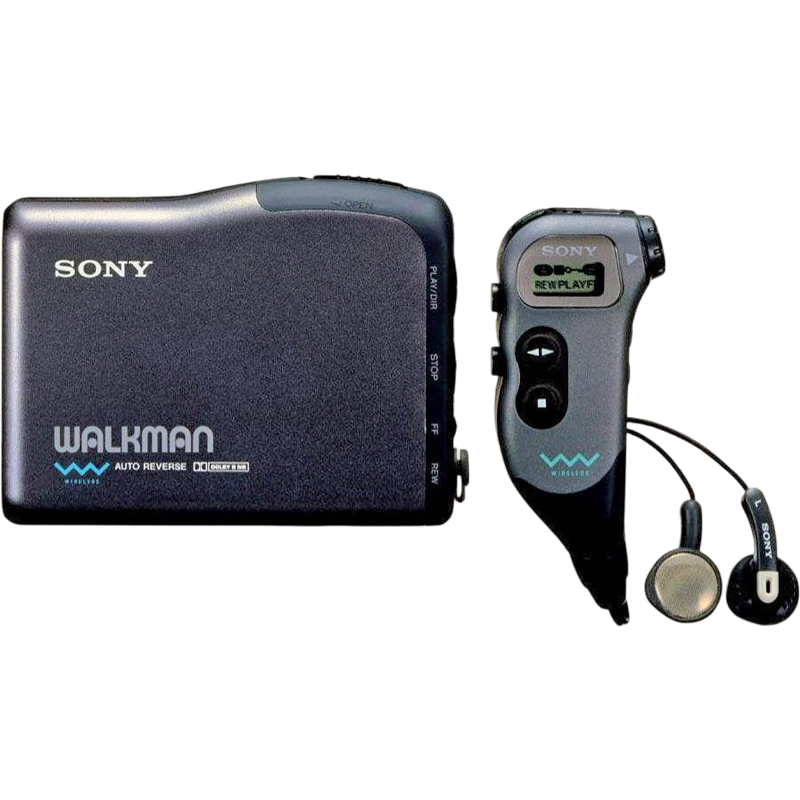
The WM-WX88 launched Sony's WX wireless series in 1991 as a cassette Walkman built around physical separation between the playback mechanism and the listener. The main unit housed the cassette transport, EX Amorphous head, auto-reverse system, and standard controls, while a separate splash-resistant wireless receiver and earphones handled listening and operation. Sony also supplied a movable waterproof storage pouch so the player itself could stay protected while the user remained mobile, making the overall system feel less of a single device and closer to a compact portable setup. This is a very revealing model because it shows Sony starting to treat the Walkman less as one object and more as a distributed experience. Instead of simply making the player tougher or smaller, the WX88 reorganized where the vulnerable and usable parts of the system actually lived. It reads as one of those strange but genuinely forward-looking side branches that only makes sense once the basic cassette Walkman had already become fully mature.
1991 was the year optimization replaced invention as the driving force behind new models. That steady improvement created the conditions for the prestige and youth-oriented segmentation that followed. 1991 left the Walkman feeling increasingly effortless and ready for more targeted identities, yet the optimization also signaled that analog had reached the limits of what it could meaningfully evolve.