ObsoleteSony.com
1982
WM-R2
Walkman
The WM-R2 was a recording-capable Walkman derived from the compact WM-2 platform and introduced in 1982...
obsoletesony.com/walkman/wm-r2

If you find it useful, you can support it. Support the archive


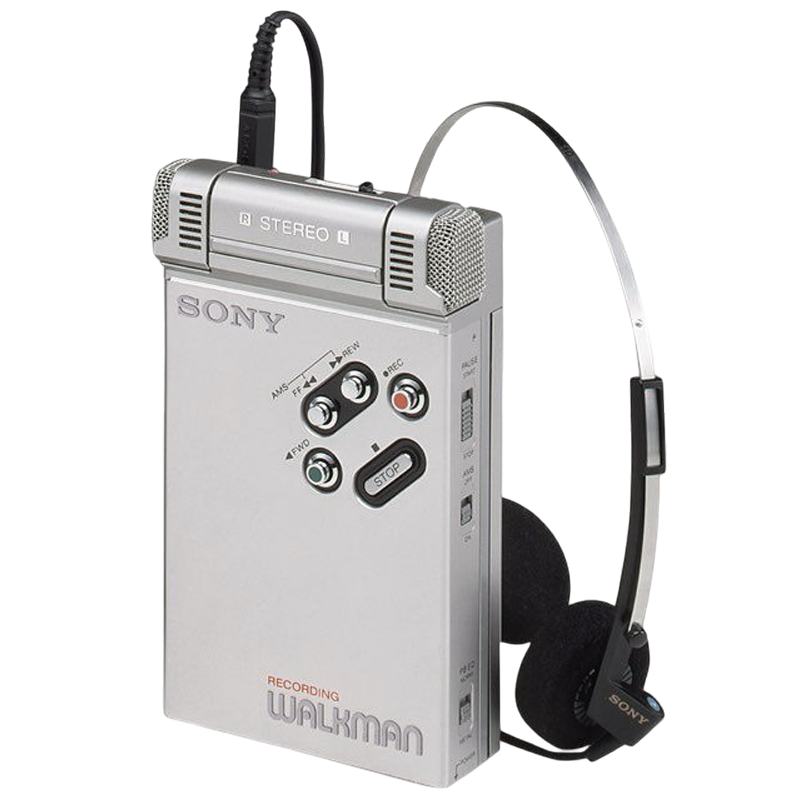
The WM-R2 was a recording-capable Walkman derived from the compact WM-2 platform and introduced in 1982 with a built-in stereo condenser microphone along the top edge of the body. It could record through the internal microphones or from external line sources, and it included a centrally placed three-digit tape counter without disrupting the basic vertical layout. Much of the physical design and control logic remained familiar, but the internal electronics moved it well beyond playback.
It filled the obvious gap that appeared once the compact Walkman format proved people wanted something smaller than a field recorder but more capable than a listening-only player. Sony did not present it as a professional tool in the WM-D6 sense, but as a more everyday recorder for people who wanted to capture things as well as hear them. That made it one of the more practical offshoots of the early lineup.
Efforts to add stereo recording to the compact WM-2 frame led to the WM-R2, a model that attempted to build a recorder upward from Sony's smallest playback design. Engineers produced the first Walkman with a stereo microphone, dual headphone jacks, and a manual transport in a housing close to WM-2 dimensions.
The proportions stayed familiar, now in an all-metal shell topped by a distinctive stereo mic. The silver mesh and tape counter gave the unit a level of precision unusual for a recorder this small.
It was a refined design, a sign that Sony wanted to test how much capability could fit into a frame of this size. Inside, the limits became clear. Recording levels were automatic, erase used a permanent magnet to save space, and recording worked only with ferric tape. Playback supported chrome and metal, but recording did not, and there was no Dolby noise reduction.