ObsoleteSony.com
1982
WM-D6
Walkman
The WM-D6 was a portable cassette recorder that went far beyond an ordinary playback Walkman...
obsoletesony.com/walkman/wm-d6

If you find it useful, you can support it. Support the archive


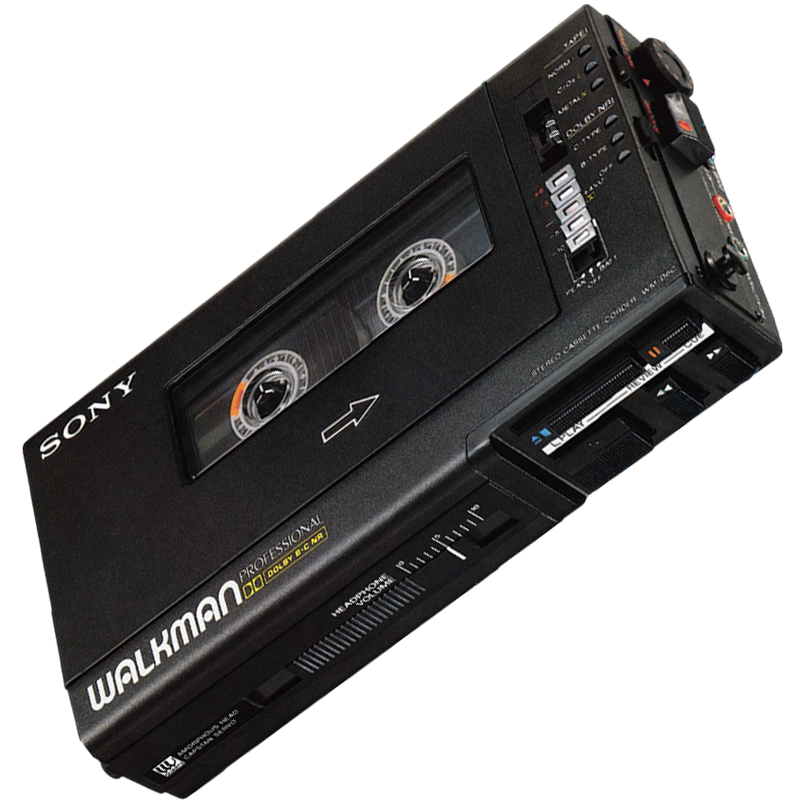
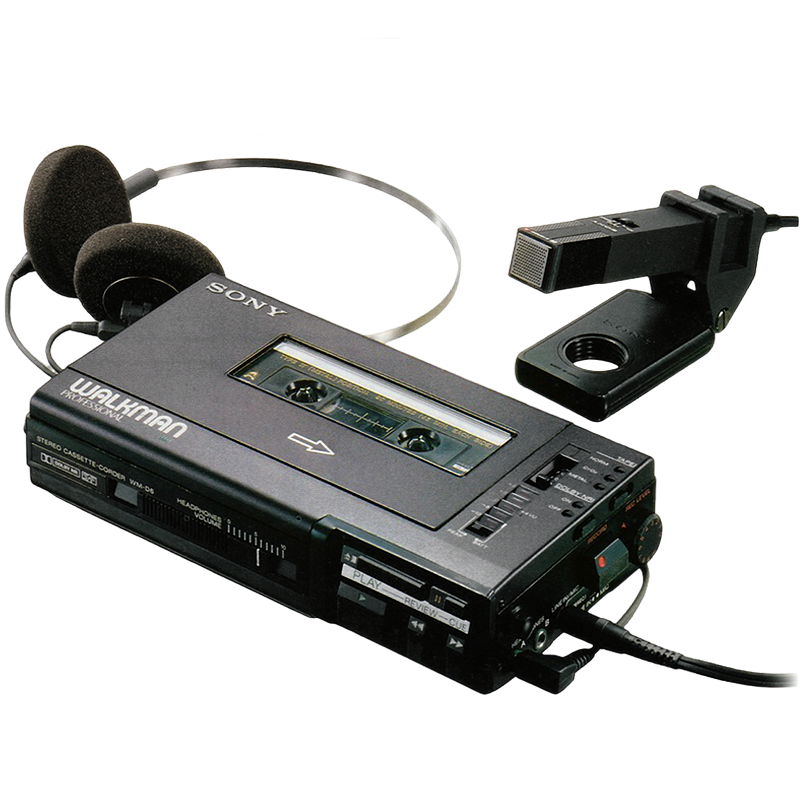
The WM-D6 was a portable cassette recorder that went far beyond an ordinary playback Walkman. Released in 1982, it combined microphone and line-input recording, manual recording-level control, Dolby B noise reduction, and a Disc Drive transport designed for much steadier operation than typical consumer portable players. Its larger four-AA body and more serious internal construction moved the machine closer to a compact working recorder than a casual handheld music player.
It belonged to a different branch of portable audio, aimed at people for whom recording genuinely mattered. Journalists, musicians, and serious enthusiasts were the natural audience, and Sony treated it less like a fashionable Walkman than a compact tool. The D6 is one of those rare models where portability was less about leisure than capability.
The WM-D6 showed that a portable cassette recorder could approach the performance of Sony's full-size professional decks. It did not follow the thin profiles of early Walkman models. Instead it adopted the priorities of field equipment, treating stability, control, and recording accuracy as its main objectives.
Its roots came from Sony's professional lineage rather than consumer Walkmans. The D6 aimed to bring the discipline of the TC-D5 field deck into a body that could travel more easily, giving reporters and musicians a tool that felt familiar in use even at a smaller scale. The D6 used a rigid metal chassis that kept the transport stable.
Four AA batteries powered roughly six hours of operation. Inside, a quartz-regulated Disc Drive mechanism monitored the capstan with a crystal reference and corrected speed in real time. Wow and flutter figures approached those of home decks, and an anti-rolling system helped prevent drift when the unit was moved during use.
Its recording system offered manual level control, Dolby B noise reduction, and monitoring through dual headphone outputs. The amorphous recording and playback head extended frequency response and resisted wear, and the straightforward layout supported interviews, ambient capture, or music work with equal confidence. For the first time, a portable recorder delivered the stability and control required for professional recording in the field.