ObsoleteSony.com
1985
WM-101
Walkman
The WM-101 was a slim rechargeable playback Walkman that introduced Sony's gumstick battery system, using...
obsoletesony.com/walkman/wm-101

If you find it useful, you can support it. Support the archive


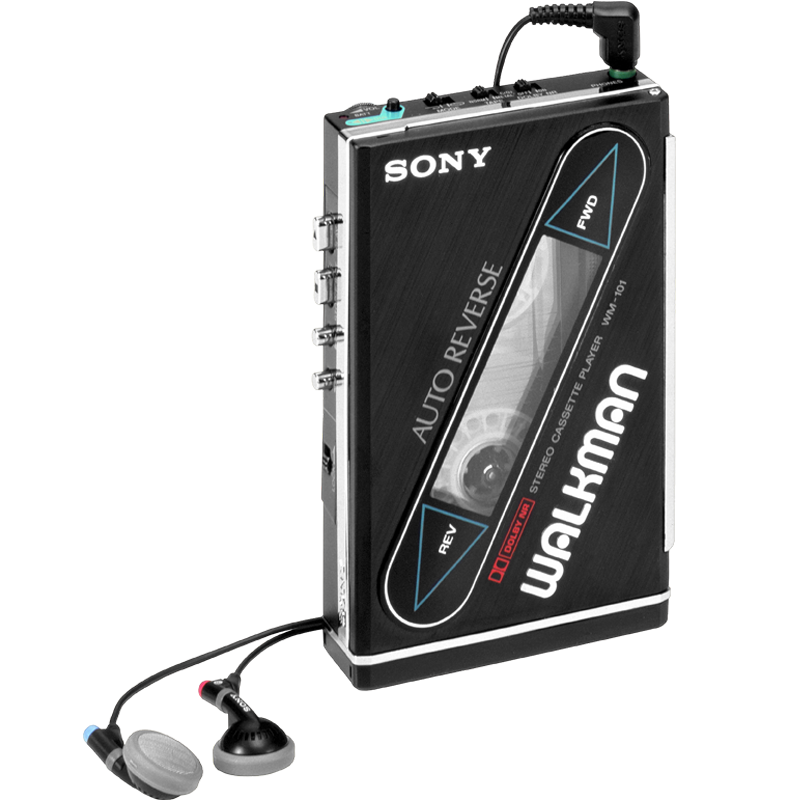
The WM-101 was a slim rechargeable playback Walkman that introduced Sony's gumstick battery system, using the thin internal cell to reduce overall thickness while still allowing an external AA adapter for longer use. It combined auto-reverse playback and Dolby B noise reduction in a metal-framed body barely wider than a cassette, with manual tape selection for normal, chrome, and metal formats. The result was one of Sony's cleanest and most forward-looking cassette players of its period.
Where earlier compact Walkmans focused on shrinking the machine around conventional batteries, the WM-101 changed the equation by shrinking the power source itself. That made it one of the decade's key transitional models, establishing the slim rechargeable format that later defined the EX-era players. It feels like the beginning of a different kind of refinement: less mechanical theater, more elegant packaging.
Sony had already experimented with fold-down mechanisms to shrink the Walkman, but the WM-101 treated thinness as a permanent design choice. It moved past the collapsible frames of the WM-10 and WM-20 and established a flat, compact form as a fixed design requirement rather than a mechanical trick.
It marked the moment when flat proportion became a standard rather than an experiment. The design required a new approach to power. A standard AA cell could not fit beside the transport in such a narrow enclosure, so a slim rechargeable battery was introduced to keep the layout compact. It provided several hours of playback, and an external AA attachment extended runtime when needed.
This arrangement became the template for many compact Walkmans that followed during the late eighties and early nineties. The WM-101 distilled the Walkman into a thin, self-contained form where size, power, and simplicity were resolved as a single design constraint.